Ingredients, decoded. INCI means International Nomenclature of Cosmetic Ingredients: the standardised names you see on ingredient lists. We’ll call them ingredients.
Glycerin · Propylene Glycol · PanthenolHUMECTANTS ATTRACT WATER AND SUPPORT HYDRATION
03
EMOLLIENT COMPONENTS
Dimethicone · Cetyl Ester Wax · Cetostearyl Alcohol · Simmondsia Chinensis Seed OilEMOLLIENTS HELP SOFTEN AND SMOOTH; DIMETHICONE CAN ALSO LIMIT WATER LOSS
04
COMFORT / CONDITIONING
Niacinamide · Allantoin · Ictasol Avena Sativa(oat) Kernal FlourNIACINAMIDE, OAT AND ALLANTOIN ARE USED IN SKIN-CONDITIONING FORMULAS
05
TOCOPHEROL + TOCOTRIENOL
Two members of the vitamin E familyANTIOXIDANT CHEMISTRY / TOCOPHEROL AND TOCOTRIENOLREAD THE VITAMIN E REVIEW ↗
Ceramides help organise the skin’s lipid layers. Humectants attract water. Emollients soften. Vitamin E compounds have antioxidant properties. These are ingredient roles; the complete formulation determines how a lotion behaves.
Your outermost skin layer contains flattened cells called corneocytes. Between them, organised lipids form a water-resistant matrix: the “mortar” around the “bricks”.
SURFACE VIEW / CONCEPTUAL ZOOM
MEET YOUR STRATUM CORNEUM. The outermost layer of your skin.
SIMPLIFIED STRUCTURAL MODEL
CORNEOCYTES = BRICKS. LIPIDS = MORTAR.
Ceramides are major structural lipids in this matrix. Together with cholesterol and free fatty acids, they form organised layers that help retain water and limit the passage of external substances.
GENERAL SKIN-BARRIER SCIENCE / NOT PRODUCT-SPECIFIC EFFICACY DATA. ILLUSTRATIVE PORTRAIT. MODEL NOT TO SCALE.
Berdyshev E. Skin Lipid Barrier: Structure, Function and Metabolism. Allergy Asthma Immunol Res. 2024;16(5):445–461. doi:10.4168/aair.2024.16.5.445. PMID:39363765; PMCID:PMC11450438. Read the paper ↗
05 / CERAMIDE DECODERREAD THE LETTERS
NP. AP. EOP. THE LETTERS MEAN SOMETHING.
NNon-hydroxy fatty acid
+
PPhytosphingosine base
A name for its structure.
NP pairs a non-hydroxy fatty acid with a phytosphingosine base. The letters describe molecular building blocks, not an exclusive skincare benefit.
Skin contains a diverse family of ceramide species. Their different structures contribute to lipid organisation. The complete system—composition, arrangement and formulation—matters together.
FORMULA / EVERY DETAIL COUNTSOBJECT / WECALM BY MONOSKIN
06 / A FORMULA WORTH READINGDETAILS A DERMATOLOGIST CAN DISCUSS
THE DETAIL IS THE POINT.
01 / NAMED
NP. AP. EOP.
Three identifiable ceramide classes. A 2–3% declaration from Monoskin.
02 / CONNECTED
A whole formula.
Companion lipids, humectants and emollients. Read the ingredients together to understand the formulation’s architecture.
NP, AP and EOP ceramides, cholesterol, phytosphingosine, glycerin and panthenol appear in the published ingredients.
This is a moisturising product, not a diagnosis or a replacement for prescribed care. If you have a diagnosed condition, ask your clinician whether this formula fits your routine.
Dryness has more than one cause. Moisturisation belongs in a gentle routine. Persistent tightness, itch or a recurring rash deserves a closer look from a dermatologist. Source
Comfort starts with understanding. An itchy or reactive feeling is not a diagnosis. Keep your routine gentle; if symptoms persist or worsen, get medical advice rather than repeatedly adding products. Source
Read for your own sensitivities. No ingredient list can guarantee that a formula will suit everyone. Check for known sensitivities and stop use if irritation develops. A small-area trial cannot rule out delayed allergy. Source
A repeating problem deserves a review. Repeated dryness or irritation can have an underlying cause. A clinician can assess triggers and recommend both skin care and any treatment you may need. Source
Support belongs beside treatment. Atopic dermatitis involves barrier dysfunction and inflammation. AAD guidelines recommend moisturisers as part of adult care. A moisturiser does not replace a prescribed anti-inflammatory treatment plan. Source
A lotion may not be the right texture. Moisturisers can support dry, scaly skin. AAD guidance generally favours a heavy cream or ointment over a lotion for psoriasis. Ask your clinician whether WECALM fits your routine; it is not presented as a psoriasis treatment. Source
08 / FAIR QUESTION
₹1,650 FOR A LOTION?
You should know what you’re buying.
A 100 ml lotion. Three named ceramides, declared at 2–3%. Companion lipids. A full ingredient list you can inspect.
₹16.5 per ml. The full formula, pack details and sources are here for you to inspect.
Marketed by / shop operatorMonocure Pharma, Office No. 1, White Cube, New Vijay Nagar, 174 Bhawrasla, Indore, Madhya Pradesh, India 453555. Purchases are completed at shop.monoskin.in.
Monoskin identifies Cetosomes as the delivery technology used in WeCalm. The product listing declares manufacture under licence from Cymbiotics Inc., USA.
Simplified technology concept / not a particle measurement.
Technology context US9084818B2 describes topical compositions with self-assembling nanoparticles and cetylated components.
The formulation idea Cetylated components and self-assembly are central to the described delivery approach. Read the patent for the technology’s design; it does not quantify absorption or clinical results for WECALM.
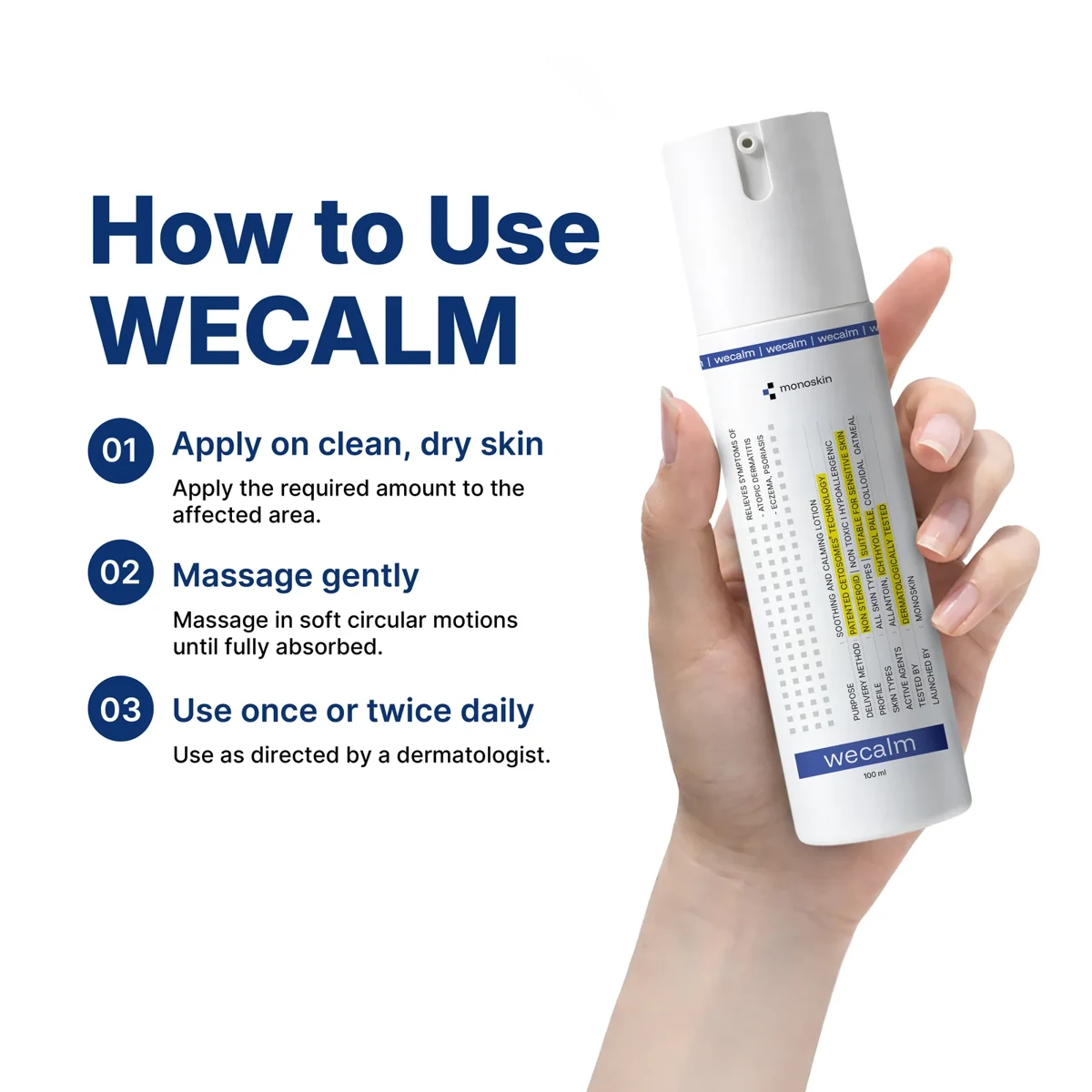
Apply a sufficient amount to the relevant areas. Massage gently until absorbed.
03
Make it routine.
Use daily, following your current pack and your clinician’s advice on frequency.
For external use only. Store below 30°C, protected from sunlight. Do not freeze. Check ingredients for known sensitivities; stop using if irritation develops.
A small-area trial cannot rule out delayed allergy. For persistent rashes or a diagnosed skin condition, seek advice from your clinician. DIRECTIONS / OFFICIAL PDP ↗
12 / GUIDANCE BEHIND THE ROUTINE
MOISTURISING. WITH A PURPOSE.
Meet the NEA.
The National Eczema Association is a US nonprofit supporting people affected by eczema through education, research and advocacy. Its moisturising guidance emphasises regular care, fragrance-free choices and checking personal sensitivities.
Scratching can damage the skin barrier and perpetuate itch. Moisturisation is one part of supportive care; ongoing inflammation or troublesome itch may need medical treatment.
If symptoms persist, disturb sleep, or the skin becomes painful, weepy or crusted, seek medical advice.
Ceramides are lipids found in the outer skin layer. Together with cholesterol and free fatty acids, they help organise the barrier that limits water loss.
Cholesterol is another component of the skin’s lipid matrix. The presence of both in a formula does not establish an optimal ratio or measured outcome.
Apply a sufficient amount after cleansing with a mild cleanser and massage gently until absorbed. Use daily, following your current pack and your clinician’s advice. For external use only.
The complete shop-listing transcription is in the “Full published ingredient list” section above. It includes the NP/AP/EOP blend, cholesterol, phytosphingosine, humectants and other formula components. Always check the current pack.
Does the checker judge whether a moisturiser works?
No. It finds recognised ingredient names in the text you paste. It cannot verify label accuracy, reveal percentages, diagnose skin, detect every synonym or predict the performance of a formula.
Does the checker save my ingredients?
No. Pasted text is processed in this browser tab, without upload or persistent storage. Sharing your findings is optional and includes a short findings summary, not the original list.
Has WECALM been tested on sensitive skin?
Yes. Its supplied adult patch study included 13 participants with sensitive skin and 13 with normal skin. The tested batch was classified Non-Irritant, with a mean irritation score of 0.19/8. Three participants had non-zero scores. Read the study summary for the conditions and limits.
Keep your prescribed treatment plan. Ask your dermatologist whether this formula and lotion texture suit your skin, then follow your pack and their directions. Introduce it on a small area first; stop if irritation develops. Seek review for painful, weepy or crusted skin, spreading rash or sleep-disrupting itch.
No. Cetostearyl alcohol is a fatty alcohol commonly used for emollient and formulation properties. It is chemically different from ethanol. Check the complete formula for your own sensitivities.
The name brings the idea of calm to the bottle. Our focus is a formula you can read and understand, from its ingredients to its evidence.
Why read the complete lipid system?
The skin barrier contains ceramides, cholesterol and free fatty acids arranged in organised layers. A moisturiser also needs an appropriate base: humectants, emollients and other formulation components work together.
It is a concentration that serves a demonstrated purpose in the finished formulation. There is no universal threshold separating functional and marketing amounts across ingredients. Assess the formulation and relevant testing together.
Humectants attract water; emollients soften and smooth; occlusive components reduce water loss. Lipid-containing formulations can supplement barrier lipids. The result depends on the complete formulation and the skin’s needs.
Regular moisturisation helps address dryness in eczema care. It belongs alongside the treatment plan recommended by your clinician. WECALM’s ingredient list and patch-study summary are available to discuss with them.
Moisturisers help manage dry, scaly skin as supportive care. AAD guidance often favours thicker creams or ointments. Your dermatologist can help choose a suitable texture and routine.
Yes—WECALM can be used in acne-prone skin routines under dermatological guidance. It has undergone patch testing that included sensitive skin. According to Monoskin, dermatologists also prescribe it alongside treatments such as tretinoin and adapalene.
What does formulated using NEA guidelines mean?
Monoskin uses this phrase to describe WECALM’s formulation approach. NEA is the National Eczema Association, a US nonprofit. Its moisturising guidance discusses regular use, fragrance-free choices, personal sensitivities and choosing suitable textures.
They illustrate ingredient order with stylised decreasing bands. They are not measured amounts. The yellow band identifies the first ceramide-containing entry found in the supplied text.
The useful question is whether the formula suits your skin. Read WECALM’s named ceramides, full ingredient list, directions and product patch-study summary, then choose with your own needs in mind.
14 / NOTHING OFF THE RECORDFULL PUBLISHED INGREDIENT LIST
THE FRONT TALKS. THE BACK TELLS YOU MORE.
Yellow identifies the ceramide blend as listed by Monoskin. Tap it for the source.
Transcribed from the official shop listing, including its published spelling and punctuation. Refer to the pack you receive for the current label. This website does not infer ingredient percentages from list order.
“Calm” is the idea the name brings to the bottle. Research and design are our starting points. Marketing is not our strongest suit—and we prefer to let the formulation do the talking.
Our founders bring backgrounds in research, design and pharmaceutical business. Their invitation: know WECALM thoroughly. Read its ingredients, understand its evidence and make your own choice.
Product facts, general science and technology context. Different sources answer different questions.
01
WECALM-SPECIFIC / OFFICIAL PDP + INGREDIENTS
What the product declares.
WECALM’s published ingredient list names Ceramide NP, AP and EOP together in entry 04, alongside phytosphingosine, cholesterol, sodium lauroyl lactylate and xanthan gum. READ SOURCE ↗
02
WECALM-SPECIFIC / OFFICIAL PACK PHOTO
The label, as photographed.
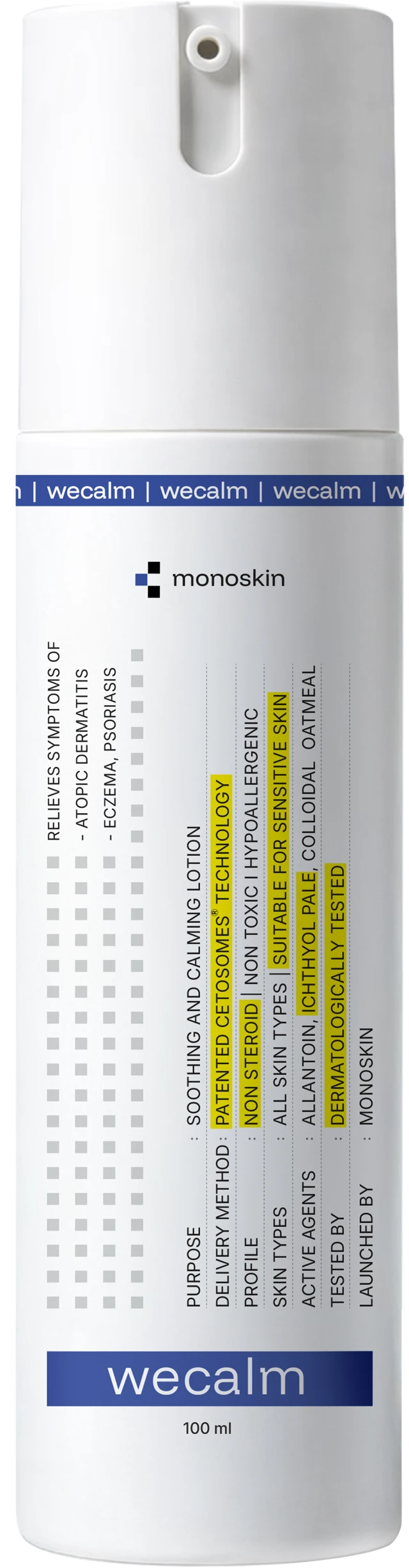
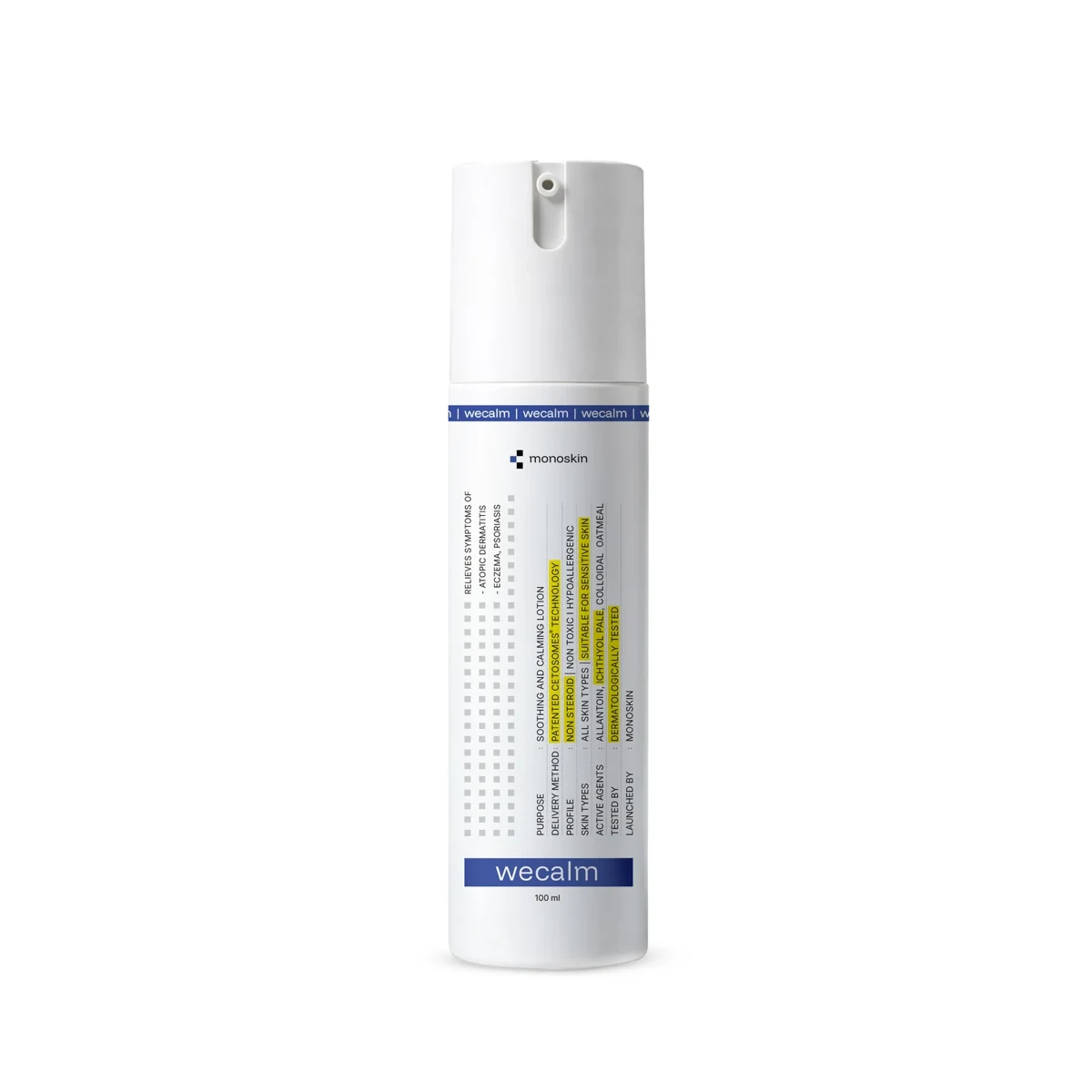
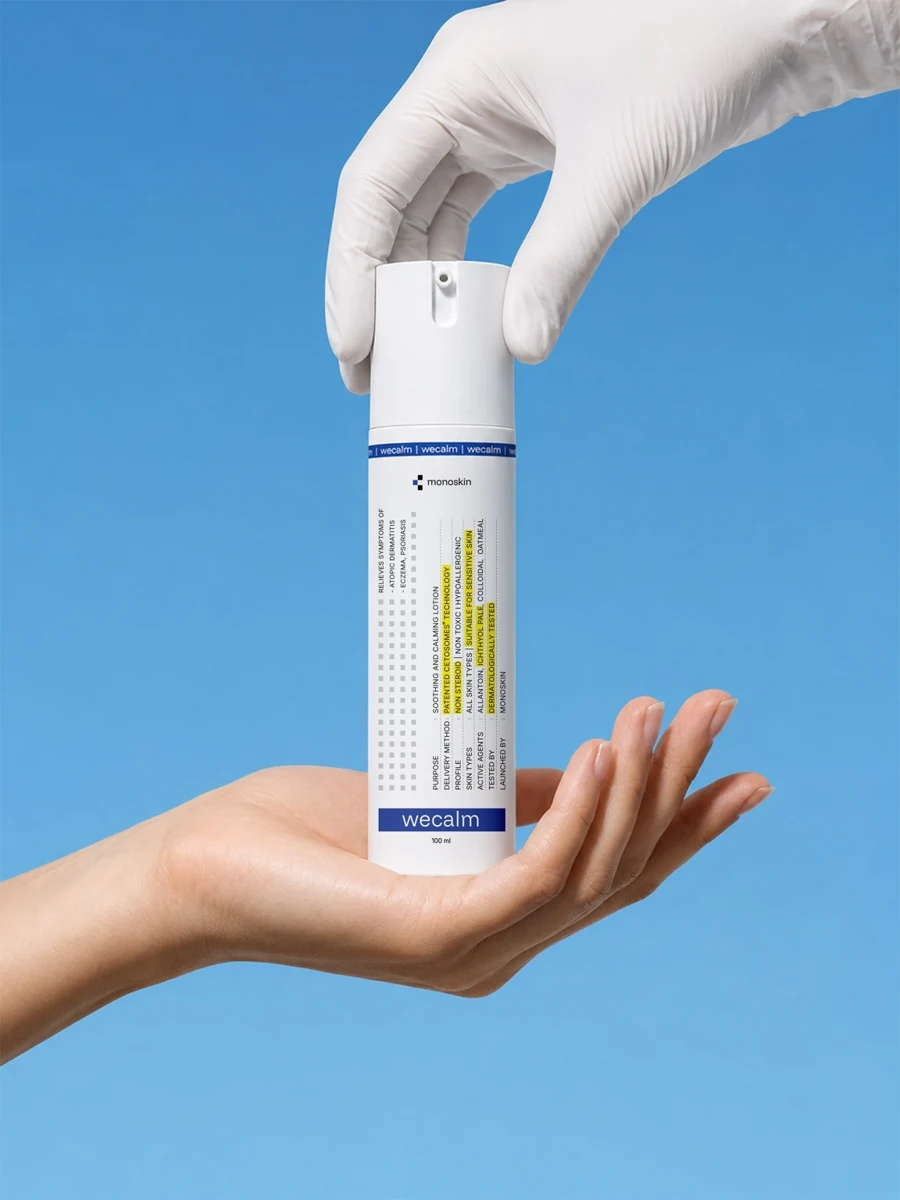
The official front image shows a 100 ml WECALM bottle. The back image provides the published ingredient and directions panels. READ SOURCE ↗
03
GENERAL DERMATOLOGY / JOURNAL REVIEW
The lipid barrier.
Skin Lipid Barrier: Structure, Function and Metabolism describes the organisation of stratum-corneum lipids. Ceramides, cholesterol and free fatty acids contribute to the intercellular matrix.Berdyshev E. Skin Lipid Barrier: Structure, Function and Metabolism. Allergy Asthma Immunol Res. 2024;16(5):445–461. doi:10.4168/aair.2024.16.5.445. PMID:39363765; PMCID:PMC11450438. READ SOURCE ↗
04
GENERAL DERMATOLOGY / CERAMIDE PROFILING
Letters with a structure.
Kawana and colleagues, 2020: Comparative profiling and comprehensive quantification of stratum corneum ceramides in humans and mice by LC/MS/MS. The naming system combines the fatty-acid type with the sphingoid-base type.Kawana M, et al. Comparative profiling and comprehensive quantification of stratum corneum ceramides in humans and mice by LC/MS/MS. J Lipid Res. 2020;61(6):884–895. doi:10.1194/jlr.RA120000671. PMID:32265320; PMCID:PMC7269764. READ SOURCE ↗
05
REGULATORY / COSMETICS RULES 2020
Order is not a percentage.
Rule 34(7) requires ingredients above 1% to be listed in descending order by weight or volume when added, followed by those at 1% or less in any order. Small-pack exceptions apply. READ SOURCE ↗
06
GENERAL CLINICAL CONTEXT / AAD
When dry skin needs care.
The American Academy of Dermatology explains that persistent dry skin may need an individual treatment plan, including an appropriate moisturiser and assessment of underlying causes. READ SOURCE ↗
07
GENERAL CLINICAL CONTEXT / AAD GUIDELINE
Moisturisers in AD care.
The AAD adult atopic dermatitis topical-therapy guideline strongly recommends moisturisers as part of care. READ SOURCE ↗
08
GENERAL CLINICAL CONTEXT / AAD
The texture matters, too.
AAD psoriasis guidance includes moisturisers for dryness and generally recommends a heavy cream, ointment or oil instead of a lotion. READ SOURCE ↗
09
GENERAL DERMATOLOGY / JOURNAL REVIEW
The itch–scratch cycle.
Giulia Rinaldi, 2019: The Itch-Scratch Cycle: A Review of the Mechanisms, Dermatology Practical & Conceptual. Itch, scratching and skin damage can reinforce one another.Rinaldi G. The Itch-Scratch Cycle: A Review of the Mechanisms. Dermatol Pract Concept. 2019;9(2):90–97. doi:10.5826/dpc.0902a03. PMID:31106010; PMCID:PMC6502296. READ SOURCE ↗
10
GENERAL FORMULATION / JOURNAL REVIEW
Reading ingredient families.
Skin 101: Understanding the Fundamentals of Skin Barrier Physiology discusses humectants, emollients and occlusive components. Ingredients can serve more than one role.Del Rosso JQ, Kircik L. Skin 101: Understanding the Fundamentals of Skin Barrier Physiology—Why is This Important for Clinicians? J Clin Aesthet Dermatol. 2025;18(2):7–15. PMID:40078856; PMCID:PMC11896616. READ SOURCE ↗
11
DELIVERY-TECHNOLOGY CONTEXT / PATENT
Inside the delivery design.
US9084818B2, granted 21 July 2015, describes topical dermal delivery compositions using self-assembling nanoparticles with cetylated components. Cymbiotics lists this patent; Monoskin attributes Cetosomes to this technology. READ SOURCE ↗
12
WECALM-SPECIFIC / OFFICIAL DIRECTIONS
Use, as directed.
The official listing says to apply sufficient lotion after a mild cleanser and massage gently until absorbed. It specifies external use and storage below 30°C, protected from sunlight; do not freeze. READ SOURCE ↗
Monoskin declares 2–3% ceramides: Ceramide NP, Ceramide AP and Ceramide EOP in WECALM. The range refers to these three named ceramides together. READ SOURCE ↗
14
WECALM-SPECIFIC / PRODUCT PATCH STUDY
Dermatological patch testing.
Report CL/144/1125/STU, dated 26 December 2025; certificate dated 7 January 2026. WECALM batch CP-EZML-026-007-003: 26 adults, 13 normal and 13 sensitive skin; one 24-hour occluded application on healthy back skin. Combined mean irritation score 0.19/8; classified Non-Irritant under the study’s IS 4011:2018 criteria. READ SOURCE ↗
15
GENERAL DERMATOLOGY / JOURNAL REVIEW
Vitamin E in dermatology.
Vitamin E comprises tocopherols and tocotrienols. These lipid-soluble compounds have antioxidant properties; topical effects depend on formulation and context.Keen MA, Hassan I. Vitamin E in dermatology. Indian Dermatol Online J. 2016;7(4):311–315. doi:10.4103/2229-5178.185494. PMID:27559512; PMCID:PMC4976416. READ SOURCE ↗
16
GENERAL CARE CONTEXT / NATIONAL ECZEMA ASSOCIATION
Moisturising for eczema management.
NEA is a US nonprofit supporting people affected by eczema. Its guidance includes regular moisturising, fragrance-free products and checking ingredients for personal sensitivities. It discusses different moisturiser textures and their suitability.National Eczema Association. Moisturizing for Eczema Management. Medically reviewed 21 March 2025; accessed 14 September 2026. READ SOURCE ↗
17
WECALM-SPECIFIC / MONOSKIN DECLARATION
Formulated using NEA guidelines.
Monoskin describes WECALM as formulated using National Eczema Association guidelines. This is Monoskin’s statement about its formulation approach. READ SOURCE ↗
18
WECALM-SPECIFIC / PUBLISHED INGREDIENT LIST
No ethyl alcohol listed.
Ethyl alcohol, ethanol and Alcohol Denat. are not named in the published WECALM ingredient list. Cetostearyl Alcohol is listed; it is a fatty alcohol. READ SOURCE ↗
Sources checked 2026-09-14. Study information is presented separately from ingredient research.
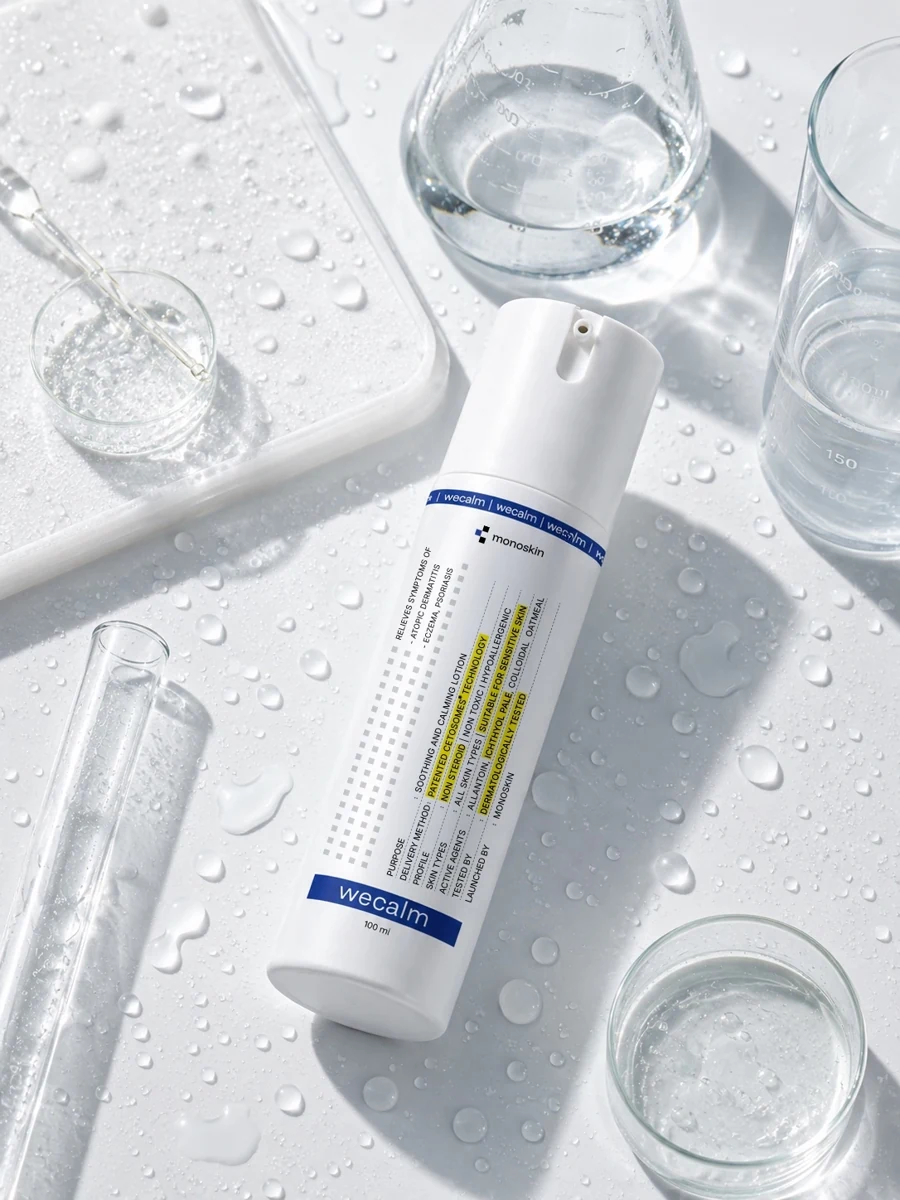
CALM / A CAMPAIGN STILL LIFEKEEP THE ROUTINE. READ THE LABEL.
Conceptual imagery, not a cooling-effect demonstration. Store below 30°C, protected from sunlight. Do not freeze.